



The LIFE-AIs project, led by Pulverizadores Fede and developed together with Agerpix, Dominio Fournier, Agróptimum and Castillo de Canena, played a prominent role at FIMA Tech, the technology pavilion of FIMA 2026.
The technology was presented within the framework of the Agricluster Innovation Summit. This event brought together key figures in agricultural digitalization, automation and robotics, becoming an essential meeting point to showcase the technologies that are redefining the future of the sector.
During the innovation session, our colleague Ana Cortés (Business Development Manager) presented the objectives and progress of the LIFE-AIs project. In her presentation, she highlighted the potential of the AIs system to improve agronomic decision-making, its ability to optimize resources and reduce the environmental impact of spraying through the reduction of phytosanitary product use, and the importance of integrating digitalization and automation in agricultural operations to improve profitability.
Her words reinforced the commitment of Pulverizadores Fede and all project partners to a more precise, efficient and environmentally friendly agriculture.
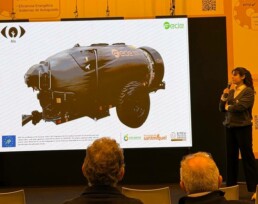
AIs system: tree-by-tree variable application at FIMA Tech
The AIs system was one of the technologies showcased within the new FIMA Tech pavilion, a space designed to highlight the most relevant solutions in agricultural digitalization, advanced automation and robotics.
During the trade fair, visitors had the opportunity to learn about the objectives of the LIFE-AIs project and the functionalities of the system. Through real-time image processing, the AIs system enables highly precise treatments. The system instructs the sprayer to open or close each nozzle individually to adjust the application according to the size and phenological state of each tree, while maintaining constant pressure and ensuring uniform distribution and deposition.
The trials conducted as part of the project confirm that the AIs system’s variable application can reduce the use of phytosanitary products by up to 43% in citrus, 48% in almond orchards, 56% in intensive olive orchards and 67% in traditional extensive olive orchards, compared with a correctly calibrated next-generation base sprayer in which all nozzles remain open.

With the contribution of the European Union’s LIFE Programme, the EU’s funding instrument for the environment and climate action, under grant agreement Project 101074540 — LIFE21-ENV-ES-Life-AIs.
Views and opinions expressed are however those of the author(s) only and do not necessarily reflect those of the European Union or European Climate, Infrastructure and Environment Executive Agency (CINEA). Neither the European Union nor the granting authority can be held responsible for them.